Heating cables
Concrete curing heating cable
Price includes 24% VAT · excl. VAT 18.17 € – 70.00 €
The concrete curing heating cable is specially designed to heat concrete and accelerate the hardening process and prevent the mixture from freezing during the winter months. The concrete curing heating cable has a 230V supply voltage and an integrated earthed plug.
The concrete curing heating cable has a secure grounding sleeve and a 1.5m power cable.
Concrete curing cable - calculation and installation
Concrete drying heating cable is specially designed to accelerate the hardening process and prevent the mixture from freezing in winter. The concrete hardening heating cable is two-core, 40W/m , equipped with a 1.5m power cable and plug and is ready for immediate use.
The concrete heating cable is equipped with a grounding sleeve under the insulation layer for safety. The supply cable is at one end of the heating cable. The heating cable is best installed at temperatures up to -15°C
– Before installing the drying heating cable outdoors, keep the heating cable in a warm room. This will make the heating cable more flexible and the installation faster.
– Secure the concrete heating cable to the reinforcement with cable ties lightly, without pulling too tight.
– The installed concrete hardening heating cable must not touch or cross each other anywhere after installation / before pouring concrete.
– The minimum installation distance between heating cable loops must be 15 cm.
– The heating cable must not come into contact with non-conductive materials such as mineral wool, foam plastic, wood, etc.
– The lengths of factory-made heating cables must not be changed!
– The concrete drying heating cable is of strong construction, but care must be taken during concrete pouring to avoid damaging the heating cables.
– Immediately before pouring concrete, you should once again check the condition of the heating cables and measure their electrical resistance, which can be found on the product label. The resistance between the electrical circuit and the protective grounding sleeve must be at least 0.5 Mohm.
– For safety reasons, heating cables should be connected through a residual current device Δln≤30mA
– Thermostats must be used to ensure the appropriate hardening temperature in the concrete (usually a minimum of +10°C).
– The connection point of the heating cable from the electrical cable to the heating cable must remain inside the concrete casting.
– The concrete casting must be protected from rain, snow and wind.
After the concrete has hardened, the heating cables can be used for some time to heat rooms. However, after the work is completed, the connecting ends of the heating cables should be cut, as these cables do not meet the increased requirements for room heating cables and their meter capacity is too high for this purpose.
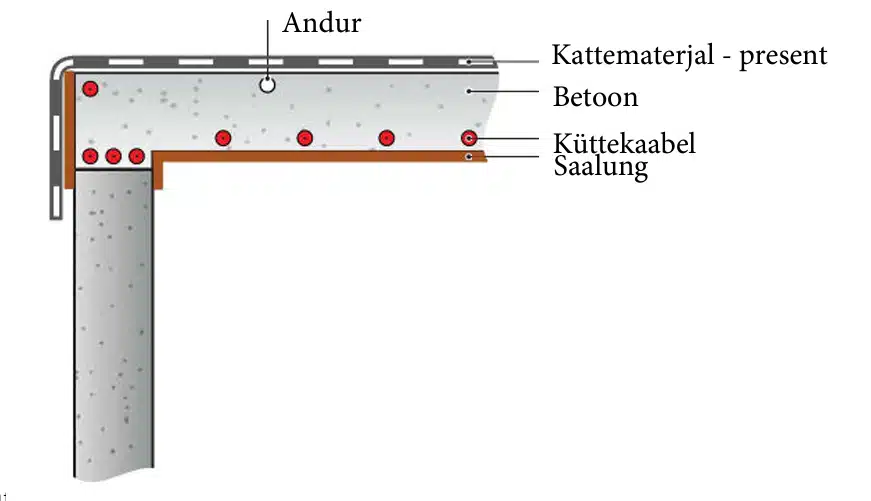
Floors, ceilings (with plywood sheathing) and other similar structures that are insulated from the bottom and sides with at least 50mm of insulation material and protected from the wind on top – 80W/m2 is sufficient. The same structure, but with a metal sheathing, is 100W/m2.
For uninsulated plywood-sandwich moldings 150W/m2
For uninsulated metal-saddle castings 200W/m2
Posts, columns, silos are calculated by volume (circumference x height) approx. 450-500W/m3
Floors that are poured on posts and that are a large thermal bridge - in these places, the heating cable must be installed twice as thick.
Floors thicker than 25cm are recommended to be better insulated on top or consider installing double the amount of heating cable in the top layer of the screed.
If the outside temperature drops below -10°C, the concrete casting must be additionally insulated to reduce heat loss.
More detailed rules for installing heating cables can be found in the installation instructions below.